As a child I took piano lessons. For years. Started in primary school and I stopped in the beginning of high school. Actually, what I should say is my mother stopped paying because my only practice during the week was the twenty minutes before my lesson. That’s it.
Let’s be honest, you have to practice – and I just couldn’t be bothered. I liked the idea of playing the piano, but not the reality of the effort it required to play well.
Years later, I could still play a little. But looking at my grade 5 piano book looked like a completely foreign language – one that I could never grasp. And when I felt the compulsion to “tickle the ivories” I stayed with the familiar and easy.
Last year on the Glass House of Music’s Facebook page, Tasi played this incredibly beautiful version of God Rest Ye Merry Gentlemen. She’s a wonderful pianist. It was so beautiful. So beautiful I actually thought – this might be something worth putting effort into.
Honestly, my goal had been to approach Tasi in the summer for lessons, giving myself a few months to learn the piece. But life! Instead, I ended up approaching her for lessons in December. ACK!
I live in Brampton and Tasi is a piano teacher in Barrie. Even if it wasn’t COVID times, I’d need to be doing this virtually. And I was nervous about learning the piano online. What would get lost? You know what got lost? Nothing! Tasi’s a great online piano teacher!
She has an amazing ear – so when I was playing, it’s not just that she heard that there was a wrong note – she could tell me what wrong note I was playing! I did have the web cam pointed at the keys, but still, she knew it even without looking. This theory was proven when the camera was pointing elsewhere!
She adjusted my fingering for ease of playing. She picked up on my bad habits and could show me where they were slowing me down or throwing me off. Tasi knew the parts that I needed her help with, and we would go over those during our lessons. My piano is out of tune, with one note sounding horribly wrong – but we worked around that hideous sounding note – only playing it when needed for the melody.
As an adult, I had more freedom in my practicing. The benefits of piano lessons in my middle age. I did it when I could. If I got frustrated, I walked away. I’m now mature enough to try and fight through the little things. So, while I still wished I had given myself way more time, because of Tasi’s help, I passably played the song on Christmas day for my own enjoyment and satisfaction.
For other adults out there – give yourself the gift of learning a song on the piano. It’s incredibly rewarding and Tasi’s a great teacher, support and cheerleader. Now the question is – what song do I want to learn next?
I’ve been asked many times before- do you ever get sick of teaching the same Christmas carols over and over? No! First of all, Christmas music is so beautiful. Secondly, it’s a different experience with every student I teach them to. Thirdly, everyone loves learning their favourite Christmas carol! So how could I possibly get sick of helping someone accomplish a goal that brings them and their loved ones so much joy?! Admittedly, I do get excited when a student asks to play a less common carol though 🤫 And last (but certainly not least), it’s a great way to introduce students to new notes and rhythms! They already know what these songs sound like, so they don’t have to overthink it. It gives them a chance to get familiar with them in a stress-free, enjoyable environment! The next time they see those notes & rhythms they will remember them from the fun Christmas songs they played, which makes it SO much easier to move forwards 😀
As for me playing carols, I always find it to be way more fun when people are singing along. I love to feel that energy in a room. I don’t think I’ll be able to feel the full effect this year due to limitations in gatherings, so I haven’t been playing them nearly as much. But every year I set out to learn a new one! This keeps it more interesting for me, and it’s kind of like a game for my family members waiting to see what it will be each year! This year’s new song is ‘I Want a Hippopotamus for Christmas’. You can check out my video on my Facebook page, which will be posted in time for Christmas next week. 🎄
I spoke of my latest project (the tattoo song), and how meaningful it was to me. It couldn’t have come at a better time, too. I was so relieved for the extra income, and I have ample amounts of time that I could spend on it. My practice time suffered slightly, but it just meant I was doing 2 hours a day instead of 3 for a couple of weeks. No big deal!
Just over a year ago, I moved to Barrie. This was after living and being a piano teacher in Brampton for 16 years. Between my home studio and the music school I taught at, I was booked full with students 6 days a week. Moving to a new city meant I basically had to start from scratch with my student base. Luckily, a few of my private students from Brampton opted for online piano and theory lessons in order to continue studying with me. I knew it would be a bit of a difficult transition, but I also knew that my studio would indefinitely build up on its own.
However, I did not account for a pandemic! It has made it nearly impossible for me to get new students. Last year I was teaching piano at a Montessori school; this year’s pandemic has made that impossible. Those students made up more than half of my local student base.
Luckily there was CERB. The only problem is that I didn’t qualify every month. The months that I didn’t qualify, I made about $100 over the maximum income allowed for the month. Now I don’t know about anyone else, but I do know that $1,100 is not enough to cover my monthly bills! Then came CRB, which I don’t qualify for because of my move last year. So things are financially quite scary right now.
Sometimes I wonder, how do I manage? Well, I keep focused and use this time to practice, practice, practice! I am exercising every day, reading more, and broadening the range of artists I am listening to. I allow myself some tv time (Netflix is my go to, to give my brain a rest, relax, and forget about the rest of life for a little while). I built a website, interviewed a favourite teacher of mine, and am writing a blog (that very few people read lol). But I won’t stop writing this blog, because it’s something to do! Something productive, that gives me a sense of accomplishment.
My hope is to have 5 solid days of teaching piano in Barrie each week. Until that happens, I’ll just keep working away and hoping for the best! It’s really all we can do right now. I just keep thinking, ‘this too shall pass.’
As a piano teacher in Barrie, I place ads for my services on Kijiji. Recently, someone contacted me with a very interesting request. They had a recording of their friend singing and playing piano- an original song they had written. She had passed away some years ago, and he wanted the song written down on paper. This way he could share a special part of her that still lived on, with her friends and family.
It was quite a time consuming project, with lots of ‘stop & rewind’ on the recording, but well worth the effort! When something is meaningful like this, it is inspiration in itself. After having finished the project, I was full of new energy to dig deeper into the pieces I’d already been practicing for months. This is one reason I will take on any musical challenge- it offers a different perspective, which is a very helpful thing!
Although my work was finished, the project was not. He is going to bring the music to a tattoo artist and have them tattoo part of it on his arm! Such a sincere gesture that will help keep her alive through art and song.
Such a tricky topic! It’s so hard to find the right balance here. It’s absolutely necessary for parents to show an interest in their children’s piano lessons and practice, otherwise the kids themselves won’t be interested. Of course they would be discouraged- they feel like they’re doing something that is boring and nobody cares about. Kids want to be where the action is! So how do you bring the action to them without intruding in their learning process? Ask questions! Arrange a weekly home performance! Give a virtual performance to grandparents on a regular basis! Sit in the room with them while they practice! You don’t necessarily have to practice WITH them- just knowing you are in the same room can make a huge difference!! Then it becomes more of a quality time activity than a chore.
This is one of the pitfalls of music lessons- practicing can seem lonely at times. And for kids especially, this is not something they want to endure. BUT, when something like a pandemic hits, practicing your instrument can be some of the best (and safest) company you can have!
My Dad learned piano alongside me for about a year! There came a point where he just could not keep up. This was inevitable, of course, since kids are able to climb a much steeper learning curve once they get into it. Just the fact that my Dad was interested enough to listen to the teacher and try to practice a little on his own made a HUGE difference in my learning. It made me that much more excited about it! And even after my Dad stopped learning, he always asked questions (both me and the teacher), and always wanted to hear what I was practicing. My Mom would sit at the kitchen table every morning before school and have her tea while I practiced for half an hour. Even though my Mom had no interest in learning herself, her being there with me was comforting and encouraging.
I just love it when I see parents who are as excited about piano lessons as their child. I know this means I will have support on my end, and more importantly that the kid will have support and encouragement at home. Because no matter how much I can pump them up in class- that’s only once a week. The majority of the work is done at home.
Thank you to all of those wonderfully inspiring parents out there!! 🤗
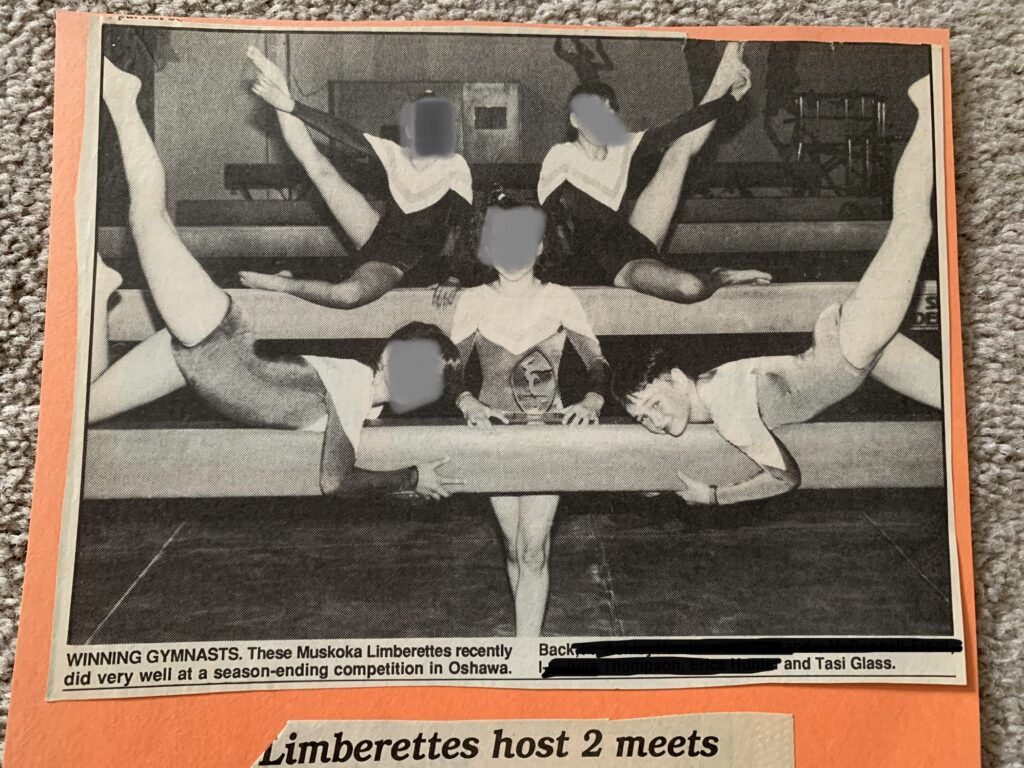
I mentioned in my very first blog post that I was a competitive gymnast as a kid. I was doing 16 hours a week of gymnastics when the piano was first brought into our home. Needless to say, it wasn’t brought there for me. My parents got it for my younger sister. We had a teacher come to our house each week to give her lessons. I would stand at the back of the room, quietly listening to everything, and would practice on my own time (what little I had). My sister, however, made it very clear to everyone involved that she did not want to take piano lessons. I begged my parents to let me play, and told the teacher how much I wanted to take lessons every chance I got. After much work on the teacher’s part in convincing my parents, and many more failed attempts at lessons for my sister, they finally caved! I was so happy. I practiced every day in the morning before school, and still continued for a year or two with my demanding gymnastics schedule. After my gymnastics coach asked my parents to increase my hours at the gym to 20 a week, I had a decision to make. It was just too much to continue with both. It was the biggest life decision I had ever made at that point (or quite possibly the only one!), and even though I knew what I had to do I still didn’t want to give up one of my loves. Looking back as an adult, I’ve always known I made the right choice. I wouldn’t trade in my music, or the experiences it has offered me, for anything. ❤️🎹❤️🎼❤️
Me and my gymnastics team, 1993:
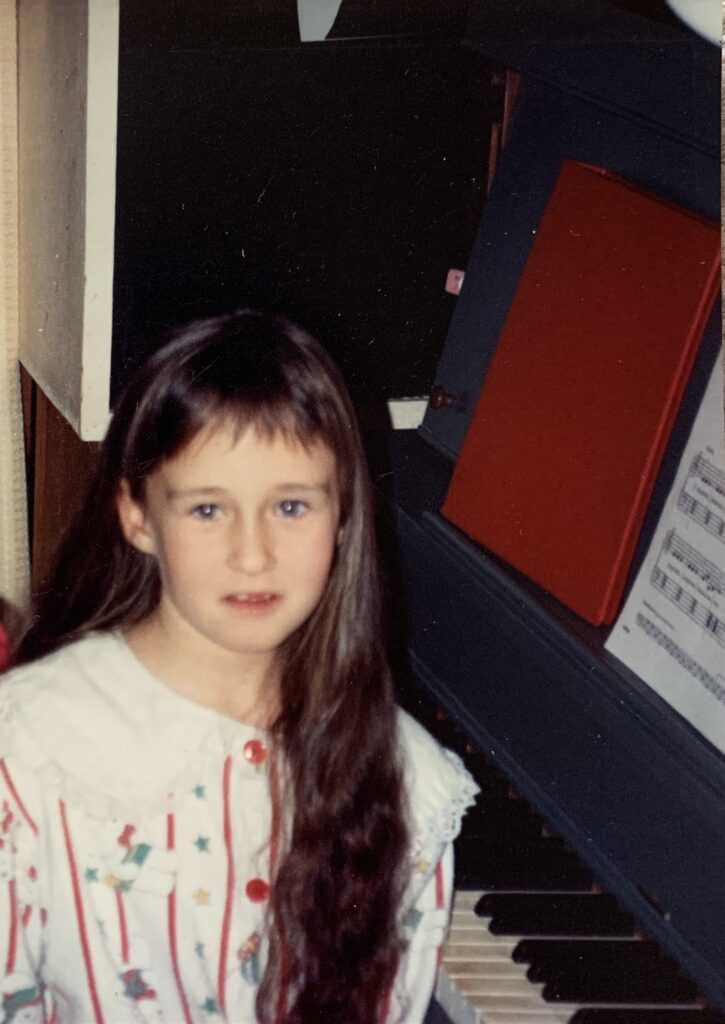
Me and my piano, pre-mushroom cut:
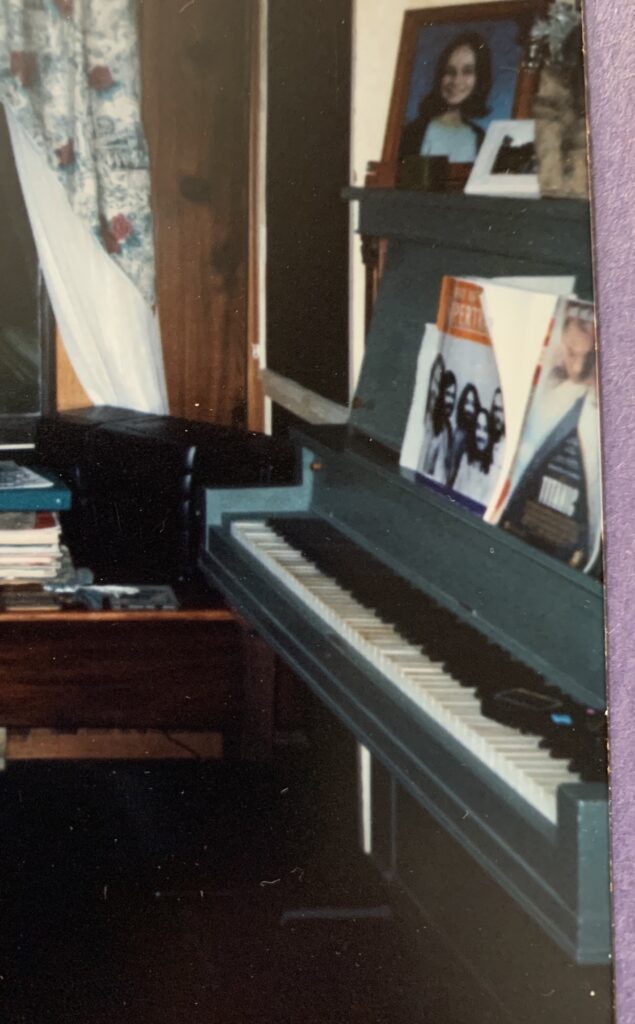
Here you can see the colour of the piano better (my mom painted it to match our living room!):
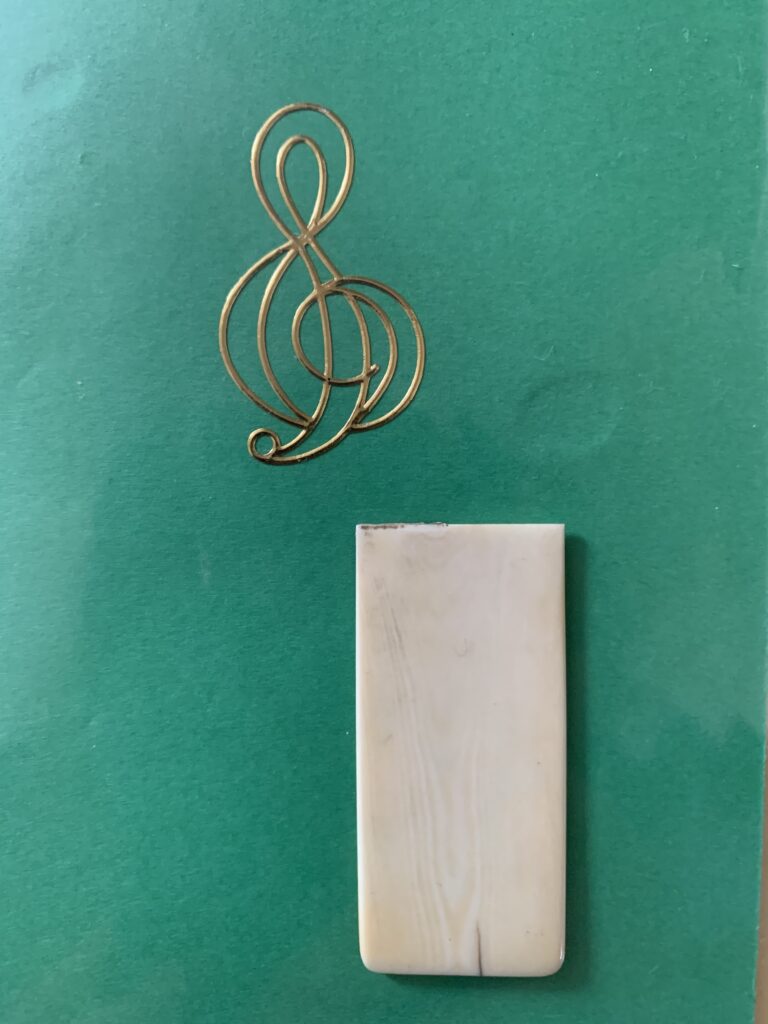
A key from my first piano (it’s real ivory, and was best cleaned with vinegar):
I’ve talked quite a bit about how music is so helpful to seniors, particularly ones with diseases such as Alzheimer’s and dementia. I see how they light up when I play one of their old favourites, or the way they gently sway to the music in their wheelchair.
What I haven’t mentioned is how close this hits home for me.
My Dad passed away almost three years ago; he spent six weeks in hospice before he died. He had multiple brain tumours, which greatly affected his personality and brain function. I had accepted the fact that I would never be able to have another conversation with my Dad even before he went to hospice, but I still wanted to see him.
While he was in hospice, one of my friends would come to visit. She’d bring her guitar so she could play and sing for our enjoyment, and when she did – she brought my Dad back to us! We still couldn’t really talk, but the emotions that came through were very real. When we cried together, he was with us again. Those moments were such a precious gift and will be with me always.
I also played piano for him a couple of times, and he went right to sleep. Now that might sound a bit like an insult 😊, but he had such trouble sleeping, or even just relaxing, that seeing my Dad able to sleep was a different kind of gift, but one that was profound for me and my parents.
Whether it’s someone with cancer, dementia, or a person suffering from a deep loneliness, I really believe music is healing. To be able to help someone, even just a little bit, or just for a moment; this is a gift in itself. I’m so glad that I can give that gift to others… and that my friend was there to give that gift to my family.
Why not both?! Ok, so realistically that’s not usually a viable option. Most people are going digital these days. It’s more affordable, they’re easier to move, never need to be tuned, and you can use headphones! This means that practice can be done at any time. Even if someone is trying to get an assignment done in the next room, or trying to catch a little extra sleep on the weekend. 😌
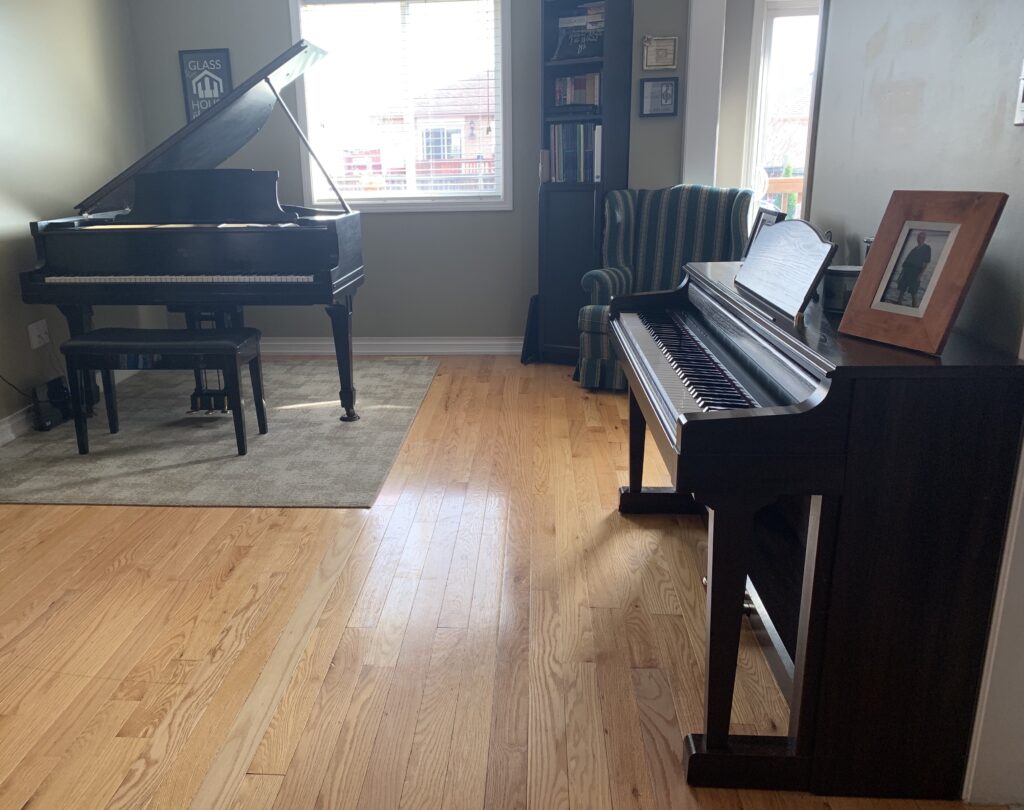
The world of piano certainly changed when digital pianos (not to be confused with electric pianos!) entered the scene in the early 1980’s. They were becoming much more popular by the late 1990’s. My parents bought my first one for me in 1999, which opened up a whole new world! But there’s nothing like an acoustic piano. They’re all different, with their own quirks. Every key is not weighted perfectly, the pedals always respond differently, and the sound varies from piano to piano. Any high level exam or important performance is done on an acoustic piano. If you’ve never tried one before, it will be very difficult to adapt to all of these variables in such a high pressure situation.
This is why I now have both! It offers me (and my students, of course), the best of both worlds. It will definitely be useful to minimize contact when in-person lessons pick up again. It also makes piano concerto rehearsals possible, and offers the ability to practice pieces written for 2 pianos. All I need now is someone else who is as obsessed as I am and wants to learn the music with me! 🎹🎶
Sometimes I get lost in the vortex, and I know I’m not the only one! You’re on YouTube and you search for a song. There are so many other enticing videos that pop up underneath it. One click leads to the next, and before you know it a half hour has gone by! In one listening session I might have listened to 10 new songs I like and discovered a new artist or two who I am interested to hear more from. It’s incredible, the amount of music that we have access to these days. I remember using dial up internet and waiting 3 hours for one song to download! It would take me a week to make one CD. Now we have endless hours of music available in no time at all, including pre-made playlists for every mood. How satisfying!
Every once in a while, somewhere in the vortex, I find a gem. Here’s the most recent one I stumbled across. Enjoy!
While Jarred Dunn has achieved a high level of playing, he doesn’t just sit on his laurels. He is always looking to improve. For many of us, when we think of piano lessons, we imagine little children clunking away, or maybe a pre-teen trying to master a popular tune. But professional performers know there is always room for improvement, and they seek out guides that can help. In our last post on Jarred Dunn, here are some of his thoughts on being a student of piano.
If you had to pick the three most influential teachers you’ve had, who would they be and why?
Jacob Lateiner taught me how to read scores. He studied with Schoenberg, commissioned new music, and was a sensational performer. He was all about the music. I studied with him from 2007, until his death in 2010.
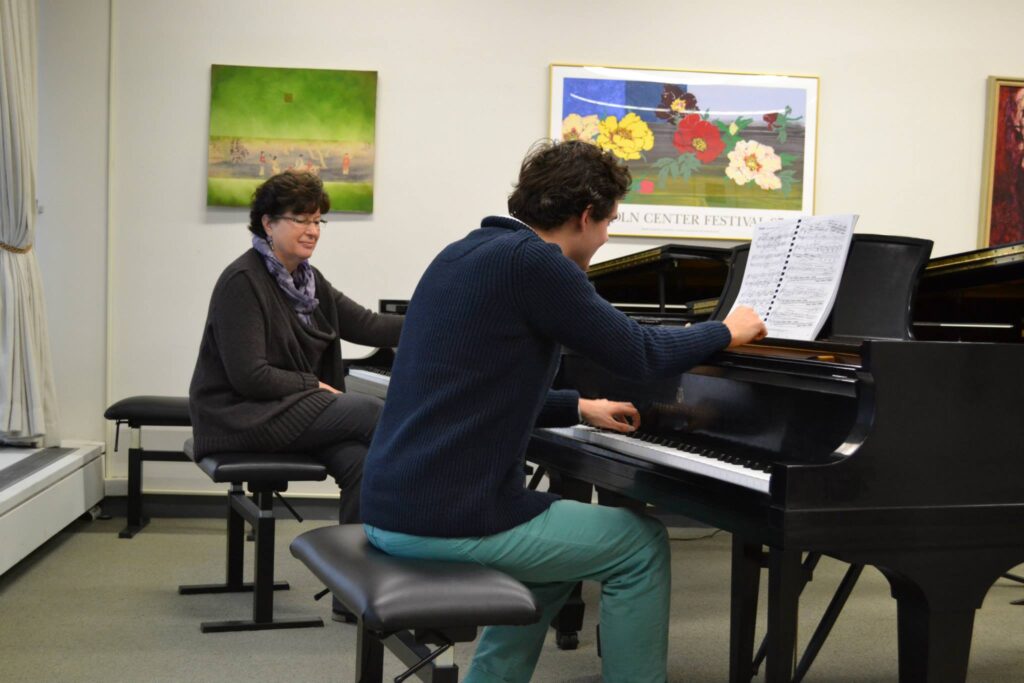
Veda Kaplinsky re-taught a sustainable technique and told me what a music career really involves. She taught me how to play effortlessly while being sensitive to the music. I met her in 2010 and I studied with her until I moved to Poland in 2014. I continued to play for her on and off until as recently as a month ago.
Dorothy Taubman taught me how to analyze the playing movements with her so-called “X-ray vision”, which I now use to diagnose technical problems. She showed me how to use the 4th and 5th fingers for the Chopin étude op.10, no.1, so that it was playable in 30 seconds! I had about 12 lessons with her in 2012, but she passed away in 2013.
How did you get connected with these teachers?
I contacted Lateiner, asking him if I could play for him before I had my audition for Juilliard. I had tried to contact Kaplinsky, but never heard back from her (she’s always so busy). One day after I’d just had a lesson, I saw her standing at the door of the studio beside Lateiner’s and I approached her.
When I was doing my undergrad in Toronto, I wrote an essay on Dorothy Taubman. Later, I heard she was still teaching seminars and so I contacted her. I felt lucky then to have contact with these great teachers, but this all became a phase because soon I got the invitation of a lifetime and my circumstances changed.
Would you be able to tell us about a few of your teachers in Europe?
I flew to Warsaw to perform and participate in some master classes, one was with Anna Górecka, who is the daughter of the composer Henryk Mikołaj Górecki. She had a different take on the technical issues my former teacher addressed. Piano came naturally to her and she described it in artistic terms, stressing that technique is simply the means to produce beautiful sound. After my first class with her, we talked about my career goals and she invited me to study with her at Academy of Music in Katowice, Poland. I thought for five seconds and knew this was the moment: about a month later I was moving to Poland and I studied with her for four years. My fourth year, I began lessons with Katarzyna Popowa-Zydrón (head of the Warsaw Chopin Competition jury) in Bydgoszcz Academy, where I later took my Artist Diploma.
Anna Górecka eventually asked me to be her assistant and to teach her students when she was on tour. This was vital for me, all of her students were fantastic and serious about their studies. They came to their first lesson prepared to be work on complex repertoire. It required me to have more than just technique to teach them, because the music was already in their fingers.
What Katarzyna Popowa-Zydroń taught me could fill several volumes. She’s one of the most intuitive people I’ve met and she knows how to listen. Her example taught me to be quiet and wait for the music to reveal itself before I do anything to it, and likewise to listen to my student carefully before I instruct. It is impossible to sum up because her teaching is so ingeniously specific that it feels like she knew me much longer than just the two years of my studies. She’s really a perfect professor.
Do you still practice every day?
Yes.
For how long?
Between 3-6 hours.
Does it ever feel like a chore you just don’t feel up to, or do you always look forward to that part of your day?
No, because if it did I probably just wouldn’t practice! It all depends on my mood. At least with a minimum of 3 hours I know I have accomplished what I need. If I’m in a fiery mood to work and am very inspired, then I can go for as long as 6.
Do you break up the practice time throughout the day?
Yes, although during my master’s in Katowice (Poland) I would often do it all at once since I had to obtain a key for the practice rooms in the school and it was preferable to do all the main work in one lengthy session. Now I do my best practicing in the morning for two hours, before I go for a jog in the lovely part of Montréal where I live. I always practice before I teach.
Have you ever come to any cross-roads in your career?
No. I was not sentimentally attached dreams about where I would go with my studies. If an opportunity felt right, I took it. I had the opportunity to pursue my doctorate at Juilliard, but McGill offered a great funding package and the allure of living somewhere I hadn’t lived before, not to mention coming home after a long time away. McGill is a more research-oriented school, and I wanted to develop my academic side along with my playing, so this was a logical choice. Now that I’m teaching at McGill it feels even more right.
What is the simplest way to summarize your view on teaching and performing?
If you listen and practice according to who you are, you become your greatest inspiration . You understand and identify with yourself more than anyone else. Any teacher knows that if they are imposing their view of the music on their students, something is wrong: we teach to inspire and ignite what is already in the student: ‘We play the way we are.’ The great performers invite us into their world, they’re not forcing us into it. They are uncompromisingly themselves, and this is the most inspiring thing. A music education – which I believe is something everyone should have – is the way to find this part of ourselves.
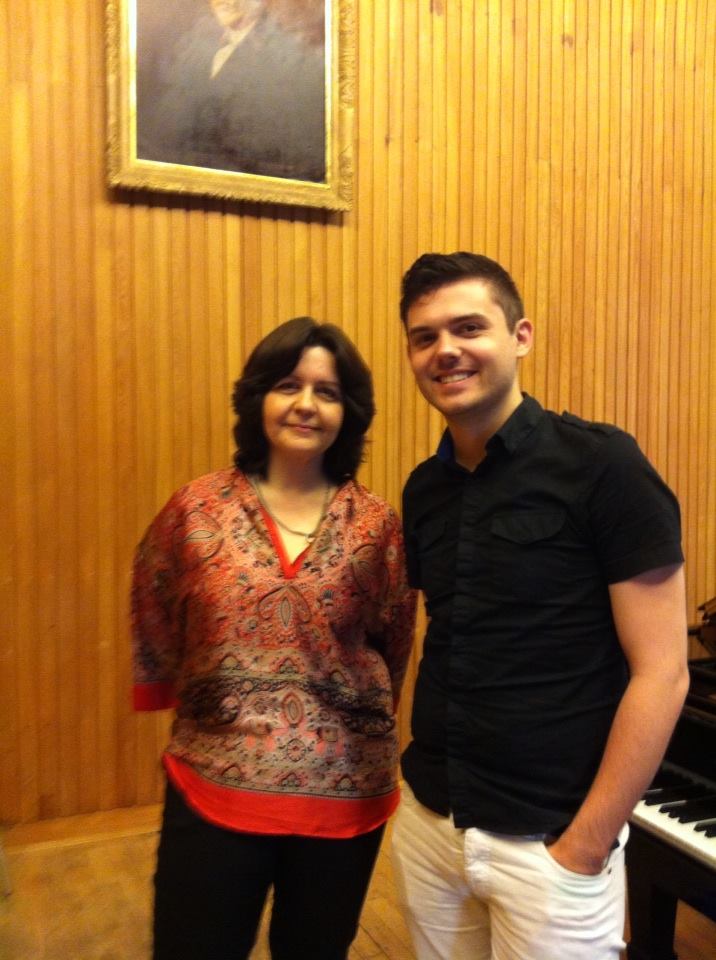
With Veda Kaplinsky (Juilliard 2013):
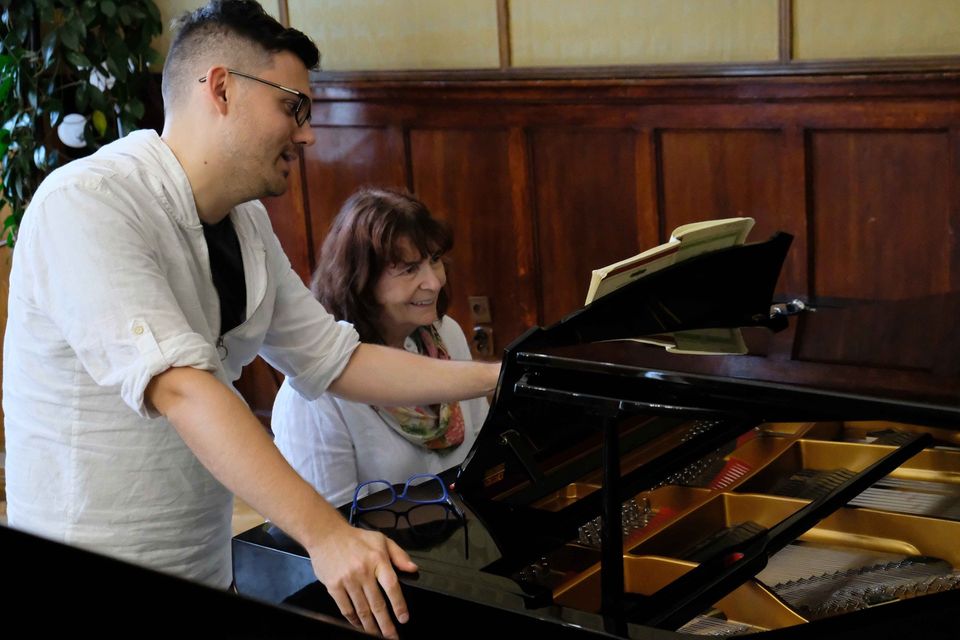
With Anna Gorecka in Warsaw, 2014 (the master class that changed everything):