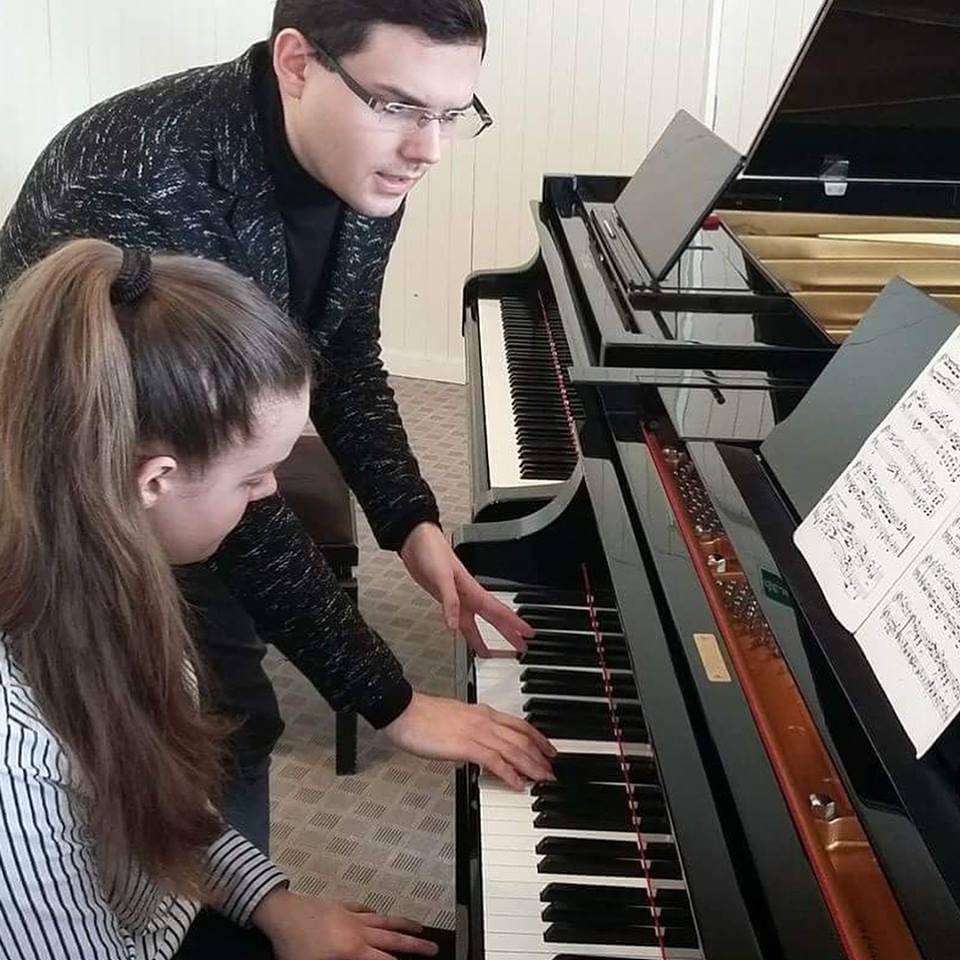
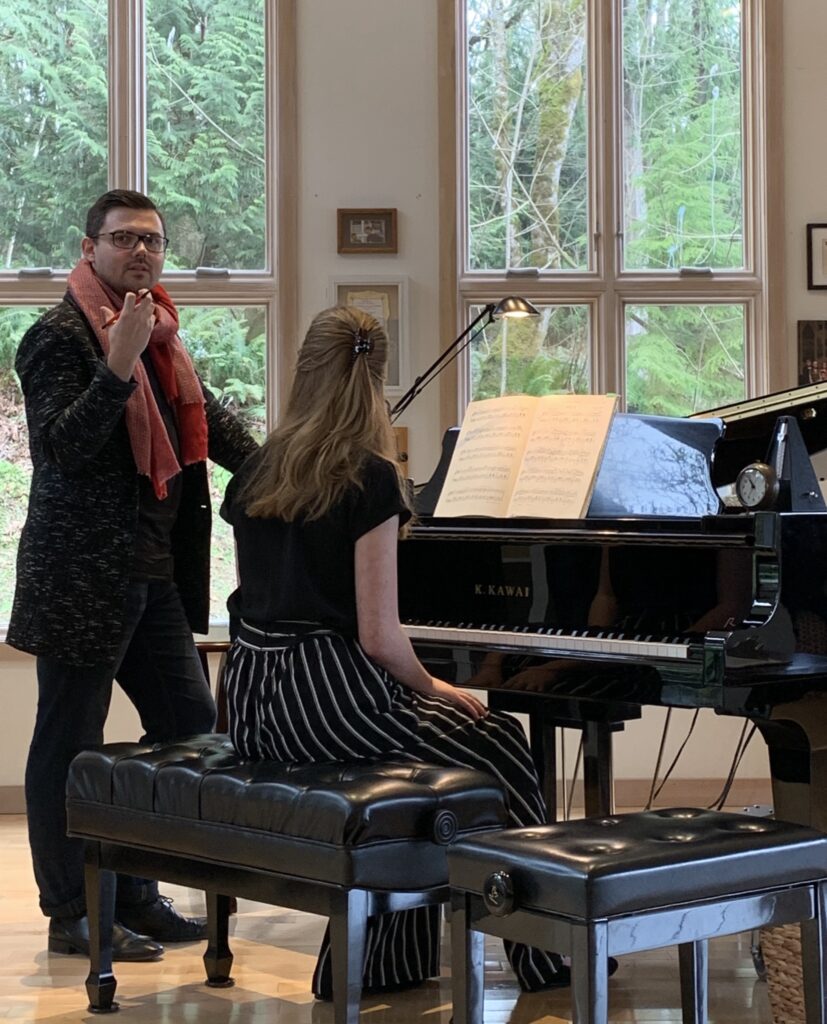
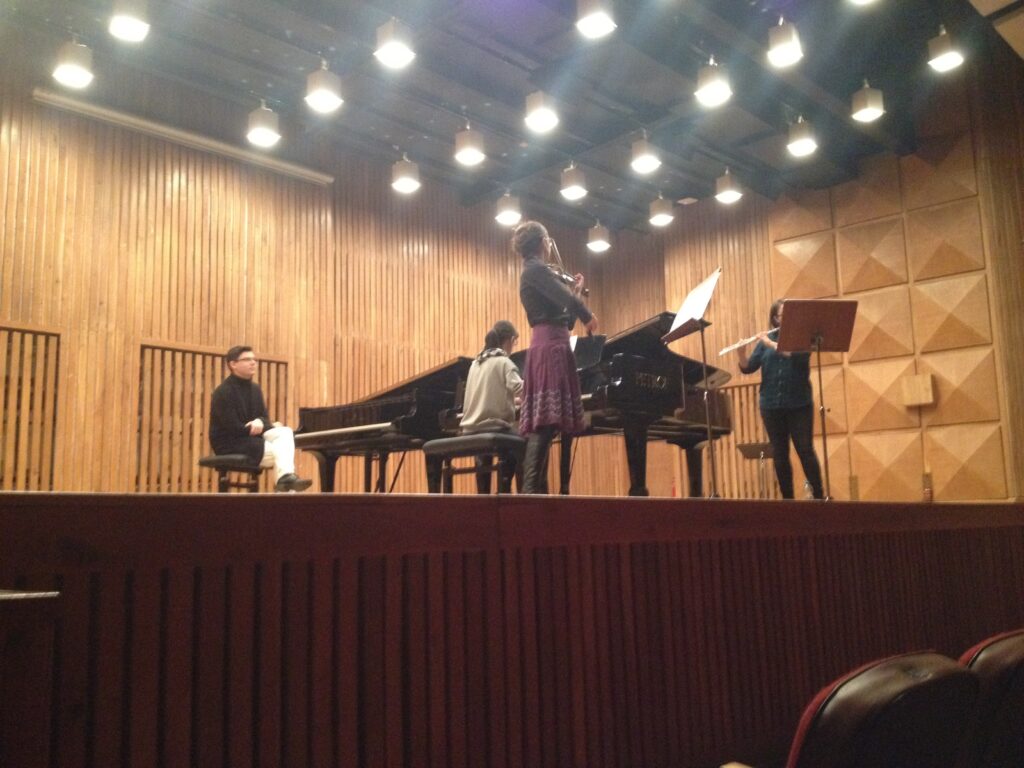
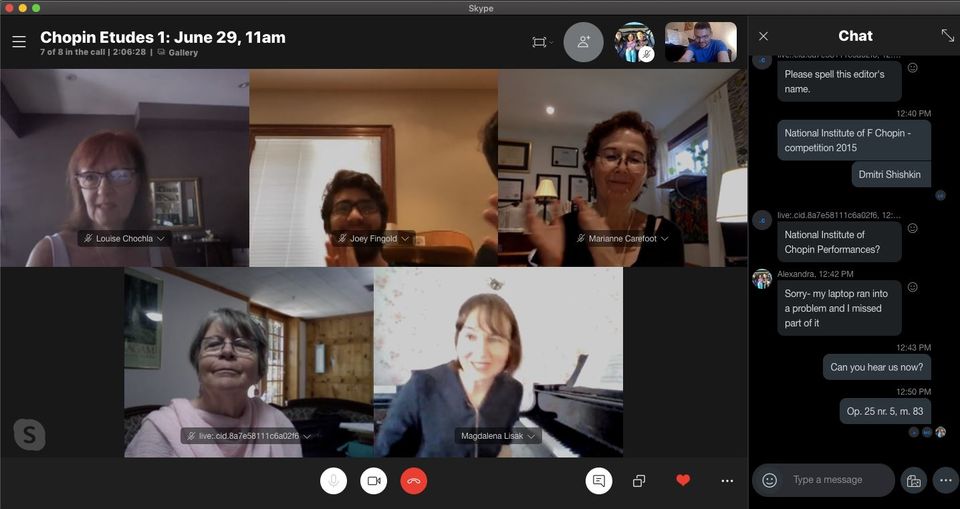
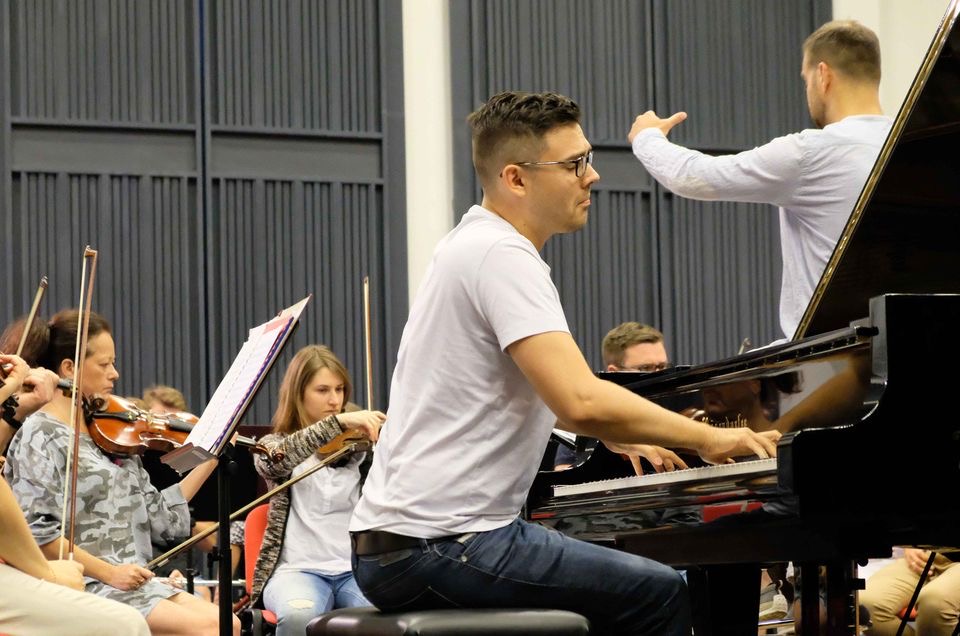
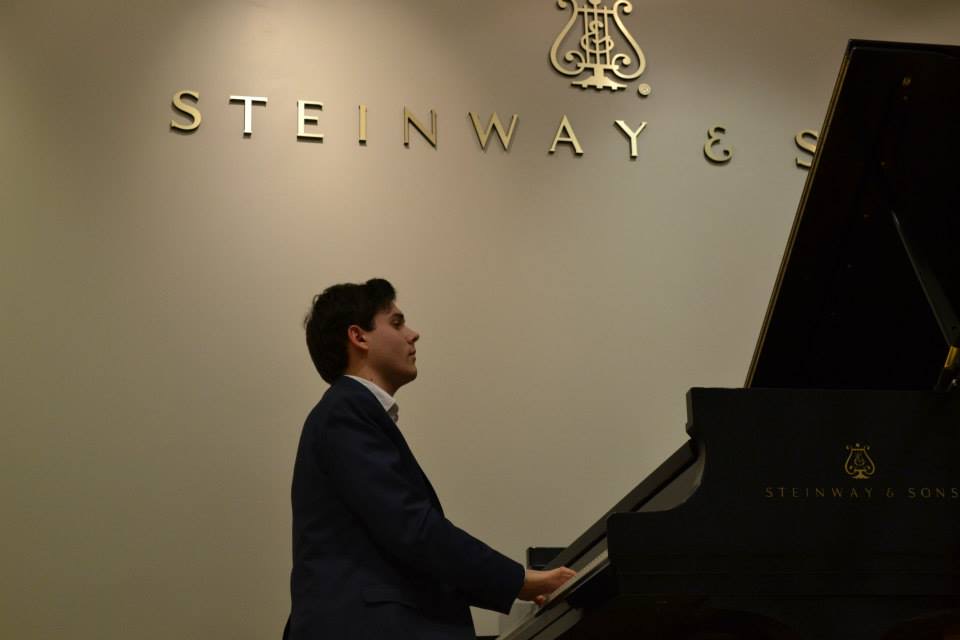
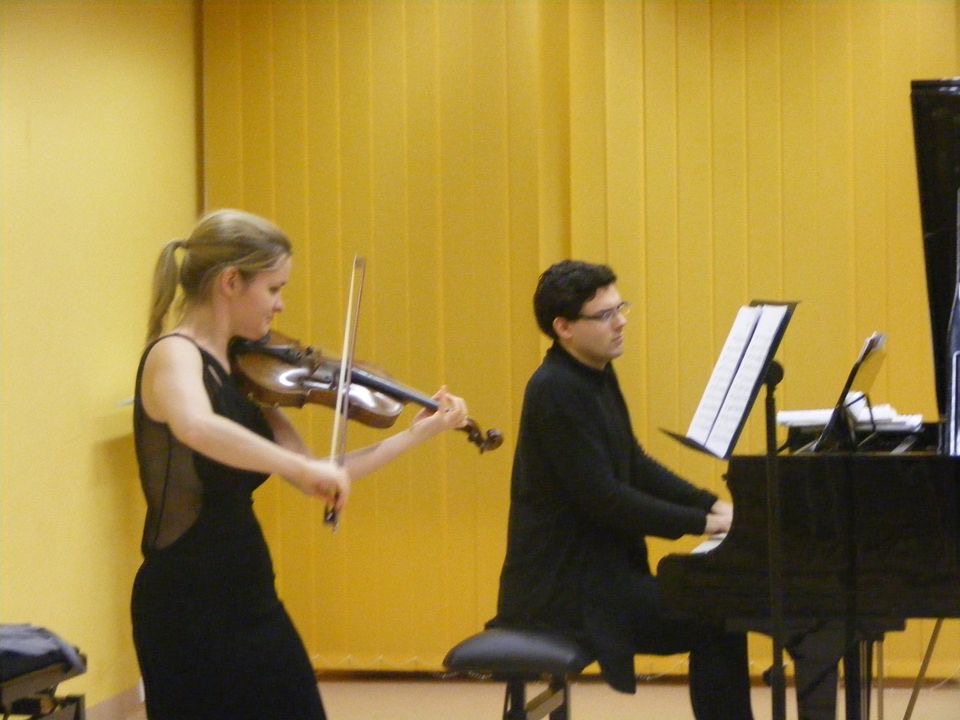
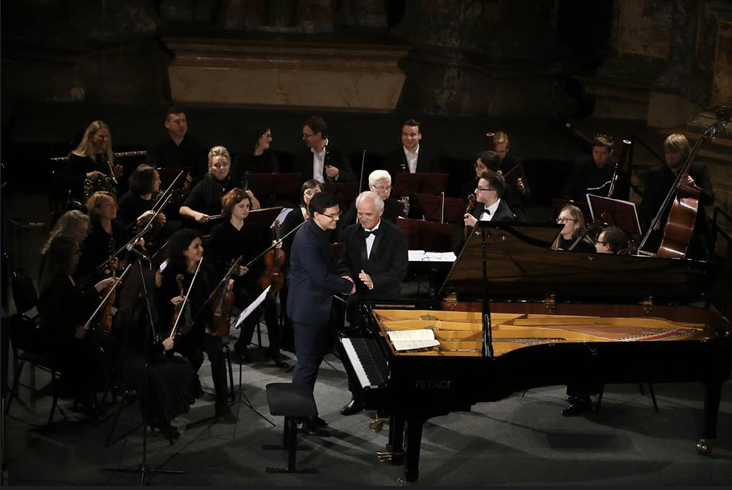
In addition to being a professional performer, Jarred is also an excellent teacher – as I can personally attest. Jarred teaches teachers, helping them to develop even when it seems there’s no more time to practice because they’re always teaching. He also accepts younger students who are already aware that they are serious about music.
This is where a teacher like me comes in… I take beginners to a level where the ambitious ones can move on to and access a teacher like Jarred.
When did you develop an interest in teaching?
After I began to play really serious repertoire at the age of 13, I became interested in helping other people learn to do it since I enjoyed it so much.
How old were you when you accepted your first student?
Fifteen.
Have you ever taught beginners?
Unfortunately for them, yes.
Could you imagine teaching beginners now, at this stage in your career?
No, definitely not. I believe I would be the worst choice to teach a young beginner, since I began learning piano at the age of two. I don’t remember the beginning stages and since then have devoted myself to playing.
If a student came to you for advice on how to pursue a performance career in music, what would be the first thing you would tell them?
Go for it. If that’s something you want, you’re not going to feel fulfilled until you know you’ve given it your best shot.
What would you suggest they do in order to try to achieve this?
The competition world is an easy way to develop your repertoire and make yourself visible to musical experts and to the public. Public involvement in the arts will happen naturally if you are an honest and real musician, and in the process of educating yourself you learn whether you have enough grit to go through with the career long-term.
If people see their child is really talented, in what ways should they encourage that talent?
They need to study with a teacher who recognizes that talent , but who maintains objectivity about what will be needed to make that talent into something marketable. The highly-developed work ethic will support that young person becoming independent and capable of making artistic choices. When sending their children for lessons, parents yield a certain degree of control to the teacher. The child may be talented, but every teacher knows that there are inter-related capabilities and some of them suffer because one area is not as strong as others. It takes a discerning ear to hear such flaws and an experienced teacher to correct them, which is why the parents need to trust the teacher to find what is really holding the child back . What all three parties need to remember (parent, child, and teacher), is that it is about the music, and they’re all working together the pursue the same end.
Everyone knows that performers have suffered greatly through this pandemic, but how has Covid affected your teaching?
My colleagues now understand how I have been doing online teaching for the past eight years, and I arranged some master classes for my students to meet one of my colleagues in Katowice through online teaching! The Covid pandemic hasn’t changed my teaching life. People now realize that they can continue with their development online, but the best development still comes from within, with the help of trusted guides, teachers, and mentors.
Master Class at Lithuanian Academy of Music Pre-College (April 2019):
Master Class at MTNA Seattle (March 2020):
Chamber Music Master Class at Chopin University of Music in Bialystok, Poland:
Digital Master Class with Prof. Magdalena Lisak (Academy of Music in Katowice), June 2019:
Jarred Dunn is a professional pianist, a Yamaha Artist, and currently works as a piano instructor at McGill University Schulich School of Music. To get to this point, a professional performer often participates in many competitions. For pianists, the world of performing and competing are intertwined. Here are some of Jarred’s thoughts on performing and competing.
[After Covid] Do you see concerts becoming the norm again anytime soon?
I hope, but I don’t know. It was already a challenge to get concerts, but hopefully more communities will see and appreciate the value of concerts after all this is over.
If you had to choose one or the other (performing or teaching), which would you choose?
Another impossible question: I have good students and I enjoy teaching them, but without my performing I could not offer what I feel is best. Teaching is a kind of performing and performing a kind of teaching: they’re inextricably linked. Ok…performing.
You recently did a social media practice challenge, where you posted a one minute clip of whatever you were practicing for 100 consecutive days. What made you decide to accept this challenge?
I told myself I had to do it.
How did you decide what to post each day?
I became quite spontaneous. I made a list of 30 composers and went through them. After I was finished that, I repeated going the same composers. But by then I was bored with my system, because systems are always boring, so I just posted whatever I wanted each day.
Do you think the contacts in your social media accounts were inspired by this?
It appears they were, because my Instagram followers increased throughout the time I was doing this (@jarredpianist).
You encouraged your students to accept this challenge as well. Did many of them undertake?
Yes, and hopefully more will in the future.
Have any of your teachers accepted this challenge that you know of?
No. Most of them hate the digital world and are waiting impatiently to return to the usual.
After seeing all the positive responses from people, do you think you will continue to post practice videos every so often?
Yes. I will post short videos every few weeks, just to keep things going. I will definitely be taking a few days off after this has finished, though.
How old were you when you performed your first concert and where was it?
I was five, and it took place in a church in Niagara Falls. I performed Beethoven Bagatelles op.126 and some Bach preludes.
Sadly, the pandemic has restricted your performing opportunities. When was your last performance for an audience?
February 2020 at the Freedom from Religion Foundation in Wisconsin.
Do you miss performing?
Very much.
Do you have a pre-concert ritual?
I practice early in the morning, as always. I make a smoothie or eat energy-boosting food a couple of hours before the performance. When I arrive at the hall, I set my phone to airplane mode and make recordings from various parts in the hall so I can hear how the piano sounds in different areas. This is particularly important when playing with an orchestra, so that I can determine how I will need to play certain parts when the other instruments are playing.
Piano and concert hall conditions always vary. I prefer to organize a thorough sound check and get to know the instrument if it’s a hall I’ve never played. An hour alone with the piano before the concert is ideal. In Katowice at the National Polish Symphony, there was one performance when I wasn’t able to do a sound check. I was playing Polonaise-Fantaisie, Mephisto Waltz, and Rachmaninoff Préludes (all are larger works), on a 9-foot grand in a smaller hall that seated about 150 people. Sometimes, I am playing on a 6-foot grand, in a hall that seats more than 600 people. This is one reason I tell my students not to decide on their interpretation too trenchantly in the first year of playing a piece. Play each bar 50 ways and then don’t decide. Decide only in the moment of performance.
It’s clear that performing would give you various advantages in your teaching, but does teaching offer you anything as a performer?
If it wasn’t for teaching, I wouldn’t have developed as much empathy and social skill, so it does offer me something personally. But on stage I just need to be myself.
Being a pianist of your standing is unbelievably demanding. Have you ever felt like quitting?
Maybe, but never seriously… Some competitions can be so unpleasant that I wondered how I got there, but when I sat at the piano I didn’t regret it. There’s no way I could quit. My relationship with the piano is good all the time. Not always great, but always good. I love that as my bottom line my career and passion are one.
What excites you most about playing with an orchestra?
I love solo performing, and with an orchestra I’m an individual in a large group. When I finish a concerto, I am a different musician because I just had deliver a dramatic monologue with sometimes 60 other musicians interacting with me at the same time, not to mention keep in step with the conductor. There are all these different voices coming at you and you have to respond. The response to these voices has to be instant and fluid: you cannot be thinking about pianistic technique at all. This is an experience I wish for all of my students to have.
I know you have performed in many competitions. When was your first?
Age 6.
Which one was the most nerve-wracking?
One in Germany in 2017, because I had to memorize a new set of pieces that had been commissioned for this particular competition.
How did you benefit from competing?
Winning the Chopin competition in Lithuania guaranteed me a year’s worth of performances in Europe and offered many master classes and workshop teaching opportunities. Travelling was a benefit, because even if I didn’t pass to the finals as I had hoped, I was then spending time exploring new cities and nearby sights.
You recently became a Yamaha Artist- congratulations! How does it feel to have that title?
Like I have legitimately distinguished myself in ways that are worthy of promoting. I’m thrilled about it.
Do you think this will open any doors for you as a performer and/or teacher?
Yes. They’re helping me with my next album.
You recorded your first album about a year ago- is that correct? And now you’re already working on a second and a third?
Yes I did. I am focusing on one album at a time, but there are two more projects on the horizon that Yamaha is supporting.
(You can find Jarred’s album ‘Chopin and Debussy’ on Apple Music, iTunes or Spotify)
Who are some inspiring figures in music, both past and present for you?
William Shakespeare contributed more to beautiful oration and poetic utterance, than did any other play-write. If a musician wants to know how to speak (music) on a stage, they should study Shakespeare’s plays and poems, or at least any poetry and arts that connect with them. These build sense of fantasy, and enough cannot be said for developing this fantasy.
Stay up to date on Jarred’s upcoming concerts through his website: www.jarredunn.com
North America vs Europe – the Classical Music Experience
Having lived, worked, studied and performed in North America and Europe (he moved to Poland in September 2014, to further his musical education), Jarred has some clear thoughts on the differences between the two classical music environments. It makes you wonder what Canadian society and culture would be like, if we embraced a more European view on musical education.
How long were you living in Poland?
Full time for 5 years, but on and off for 6.
What were some of the biggest differences you found when comparing musical education in North America to Europe?
In Canada, higher education costs money. In Europe, higher education is free.
If a parent knew they could send their kids free of charge, for a couple of hours per week for personalized music lessons with a highly qualified teacher (which is essentially learning the use of the body and mind, creativity, expression, clarity, discipline, helps math and linguistic skills to develop faster), I can’t think of a parent who would turn this down unless the child was not interested. The students in Europe are studying with professors from elementary school. Music is a part of the education as much as science, mathematics, language acquisition. In Canada, it’s an extra privilege that is the first thing to be taken away when the economy becomes even slightly unstable.
Is one place more competitive than the other in terms of performances, connections, and career goals?
In Europe, the possibility for a career is much bigger. Music is easily accessible, and it’s part of the national narrative to have artistic and cultural heroes. Imagine if you walked by statues of our musical icons every day and streets were named after them in every city.
In Poland, there’s a very system in place for music education, similar to how it works in North America if you want to become a doctor. Furthermore, if you decide you want to become a professional musician and you practice to this end, then there are many (more) outlets available to you to accomplish that.
How do you feel classical music enriches the world?
When we listen to classical music, we are listening to ourselves and our fantasies, imaginations and emotions. This gives us a sense of unity within our individuality.
When it comes to classical music, where do you think the Canadian scene should go?
Upwards, quickly. We need to make music accessible to as many people as possible: and this is the basis of the free education in Poland.
Do you have any ideas on how to make this change happen?
We are still figuring out how to keep audience numbers up. Marketing isn’t such a well-understood practice here as it is in the United States, nor is music as generally accessible as it is in Europe. There isn’t as much focus on building community concert series, or gaining enough financial leverage to keep a series alive. If we could focus more on music education in public school systems, and having more access to private lessons, I think our lives would be much richer and easier. I know of arts-specific high schools that do try to balance between usual curriculum and an arts-intensive education, but the fact is that private lessons — the space to develop a student into a performer — are often too expensive. In order to become an artist, you need to be steeped in the discipline for a long time. We should also encourage and help facilitate students to be able to study abroad.
What were some of the biggest differences you found when comparing musical education in North America to Europe?
If you go to Europe to study music, you learn that music is life. There are so many great teachers in Europe. The ones that I studied with just happened to be the ones that I clicked with. To become a renowned professor, one has to have tremendous performance career or be able to teach in such a way that after only a few hours, the student plays significantly better. You really have to be able to change the fundament of the student. Sometimes in Canada we are caught up in the process of learning that we forget that sometimes it’s best to make changes decisively. Do the work right here and now. As a teacher, that’s a very valuable habit. Sometimes it’s as simple as ‘you’re playing too fast’ so you need to stop playing like that: make the change. Now. Forget about what process we’re going to use to make it happen and just do it. This is a broad statement but I have seen that music education in North America emphasizes well-roundedness whereas European education emphasizes specializing in one discipline at a time.
Performing Mozart Piano Concerto in A Major, K488, with Lithuanian Chamber Symphony in Vilnius (November 2018)
In this post, I interview Jarred about his love of Chopin. Jarred is known as a Chopin expert, and in 2018 was the First Prize and Concerto Award winner of the prestigious Lithuanian International Chopin Competition (Vilnius).
What was the highest point in your musical life so far?
There are many! One great moment of my life was when I played at the Chopin museum in Warsaw. I love playing concertos with orchestras. Winning the Lithuanian Chopin Competition meant I had a year of traveling for concerts and teaching master classes. Moving to Poland from New York, two places I had always dreamed of studying, and studying with great teachers. Any opportunity to make a choice that develops who I am and deepens my contact with art is a high point. My whole career feels like a high point because I still can’t believe this is all happening.
I know you perform many different composers’ works, but let’s focus on Chopin for a moment. This is where it all began for you, isn’t it? Why Chopin?
When I first played Chopin, yes. This was the beginning of my musical life. When I perform Chopin, it feels like I just took off my hat and my coat, and I am home: everything is as it should be. When I teach Chopin, it’s never enough, I have always something to add to what my student plays. I love to read about Chopin, yet I know I will never really know anything about him. It’s intriguing: Chopin was an introvert, yet so extroverted about his love of the piano, and only allowed himself (so it seems) to be understood through the music he composed.
Did you come to an even deeper understanding of Chopin’s music by living in Poland?
Yes, of the mazurkas specifically.
If you could have the chance to ask Chopin himself one question, what would it be?
Just one? Explain yourself, Chopin: would you please play for me every piece you composed?
Do you have a favourite Chopin interpreter?
No. It constantly changes. Argerich, Zimerman, Richter, Ashkenazy, Lugansky, João-Pires, Horowitz, Blechacz, Lhevinne, Rubinstein. Popowa-Zydroń is my favourite right now. She interprets Chopin so personally and makes very intimate moments without becoming sentimental.
What is your favourite Chopin piece to play?
That’s truly impossible, but right now it’s Polonaise-Fantaisie.
Listen to?
Today it is Chopin’s F-sharp minor Polonaise, although 20 other titles just flashed through my mind.
Watch a performance of?
Chopin études. They are so spectacular. It’s interesting to watch different people play them, to see the different movements people use.
In 2014, I spent about six months trying to get back into serious practicing after a five-year lull. I needed more than just determination. I needed inspiration.
During this time, a colleague sent me an email about an open lesson with Jarred Dunn. (An open lesson is when there is an opportunity for an audience to watch someone’s piano lesson.) Jarred was introduced as a Chopin expert, so immediately I was intrigued. Jarred would be teaching a high-level student that had always impressed me. I needed to see this.
The lesson was two hours long, but the time flew by. I was completely taken away by Jarred’s understanding and love of the music, his incredible ear, and his ability to demonstrate such difficult pieces so easily. I guess you could say I was a little star-struck.
After the class, Jarred invited many of us to a teacher workshop he was holding the following month. I was a little nervous in accepting- the schedule and the cost of it were more than I had anticipated. But going to that workshop changed my life. I met some really great piano teachers in the area, and all of us were just amazed by Jarred. It had been a very long time since I felt so inspired!
So, of course, I inquired about private lessons. I had a couple of lessons with my new teacher that summer before Jarred took off for Europe.
I had my first Skype lesson with him that fall. I was pretty skeptical about online lessons, but it turned out to be great. I could continue to study with this amazing teacher who was halfway across the world, furthering his music studies — far beyond what I would ever be capable of doing. I’m even more thankful now that I decided to pursue online lessons with him. It prepared me for teaching during this COVID-19 pandemic since all lessons need to be taught online. I know a lot of music teachers have struggled with this change, but I’ve had plenty of time to adapt, thanks to Jarred.
I was Jarred’s studio assistant for two years and worked closely with him to organize his schedule, master classes and workshops. It was one of the busiest times in my adult life. Jarred lives and breathes classical music. He continually undertakes an incredible workload, and never shows any signs of slowing down. He reads more academic books in a summer than I have probably read in my lifetime and has a naturally eloquent manner about him. The music he’s capable of playing, and regularly performs, makes the difficult repertoire I am learning look easy. As a performer, Jarred has this fascinating ability to transport his audience to another world.
I’m sure most of you have heard the saying ‘when the student is ready, the teacher will appear.’ This is exactly what happened to me with Jarred. I still can’t believe how lucky I am that he was the teacher who appeared.
That open lesson in 2014, opened the door to the next chapter of my piano life. As you can see, Jarred Dunn is an important player in my musical journey. Over the next five blog posts, I would like you to get to know him a little better, so I’ll be sharing an interview I did with him a little while ago.
In the meantime, take a look at the video below of Jarred playing…..
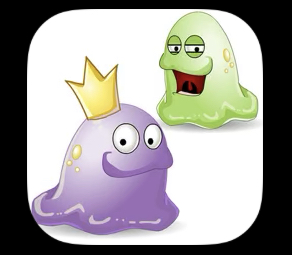
Have you heard of the blob? Actually, it’s called the Blob chorus. It’s an app that I often use while teaching young children.
One of the things students first learn is pitch. It’s about training their ear to notice the different sounds that different notes make. Some kids are naturally musical, and they can pick out notes by ear quite quickly and easily. Other kids need more help.
I might use the Blob Chorus for about 3-5 minutes in some lessons. The Blob Chorus is a tool that helps children identify pitch. It’s a game where there are a few blobs, and each sings a note. After all the regular blobs have sang their notes, the Blob King sings a note. Children then pick which regular blob sang the same note as the king. If they get it right, they’re presented with new blobs singing new notes. If they get it wrong – the blob they picked explodes!
Here’s something I’ve noticed – most of the boys love, love, love this app. I have one student who is not quite 4. He’s the type of kid who is just happy all the time, always smiling. Always excited for his lessons. But he is a prime example of a little boy who just looooooves the Blob Chorus. Some girls, on the other hand, are actually afraid when the blob explodes! I get it – it’s a bit sudden, (although I kind of love it)!
For kids that are really good at identifying pitch, I can adjust the app to a higher degree of difficulty – more blobs singing notes more closely together. For children that don’t quite have an affinity for pitch, we can start easier – maybe only two blob choices.
It’s a great tool to help kids learn about pitch, but also one that I can adapt to each child’s level. We only use it for a few minutes at a time – I don’t want piano lessons to become about screen time! But because it’s a game, because it’s an app, and because it’s cartoony… it has become a great teaching tool.
When you’re teaching pre-schoolers you need to have energy. Especially for those kids with a lot of energy. You know the ones…they want to jump from activity to activity. You need the energy because you have to keep up with them! But I also want to show them that music, and the piano specifically, is super exciting!
No matter what age you are when you begin learning, there is so much to learn. Pre-schoolers in particular though, are learning SO much and SO fast! But they haven’t yet developed the fine motor skills necessary to be a pianist. So at the start, I don’t teach them to read music or teach them piano technique – I teach them ABOUT music.
One of the things that I work on with students is rhythm. Rhythm is an important part of music. Some might say the most important part. Sometimes I have the students clap along to a piece of music, press down random keys on the piano in time with a song, or use rhythm instruments such as tambourines. Other times they get to march around the room in time to the music. For those high-energy kids, marching is a great way to keep them engaged!
Having kids move around while learning works especially well when I notice that the child might have just a little too much energy in their ‘engine’. (For more information on the self-regulation engine alert theory, check out this CBC radio documentary at https://www.cbc.ca/radio/thesundayedition/how-does-your-engine-run-documentary-1.2445082).
Here’s another perk of teaching children rhythm – children who aren’t naturally musical, or those that struggle with pitch, can pick up rhythm and see themselves do well. Rhythm is innate, which means we are born with it. It doesn’t need to be taught, it needs to be developed.
Giving children a way to succeed is always a good way to keep them engaged and allow them the chance to enjoy learning piano!
At what age should you begin? I think 4 years old is a good age to start. Kids are really starting to pick things up… they’re learning their alphabet and numbers, some are able to tell right from left, and they’re all in school by this age. This past school year (pre-pandemic), I spent one day a week teaching at Meadow Creek Montsssori school here in Barrie, so some of my students were actually as young as 3.5 years old.
This is young. Some of them seem super young. And most kids that age come with a lot of energy.
Excited Energy
Scared Energy
Shy Energy
Super Star Energy
Hyper Energy
To be a good piano teacher, I need to be able to adapt to each child.
Recently I was teaching a shy little girl, which wasn’t something new to me. We’d had a few lessons together and she’d always seemed quietly wary. But one day, this little 5-year-old just seemed overly anxious. She didn’t want to speak at all. Didn’t want to play. Didn’t even want to just listen to a song from a CD. And halfway through the lesson, she looked liked she wanted to cry.
She just seemed so overwhelmed.
Piano lessons aren’t meant to be traumatic.
So, on rare occasions, I have call it a day. In this case, I ended the lesson early. It’s a half hour lesson – so she only got 15 minutes of teaching… or another way of looking at it is that she only missed 15 minutes of teaching.
I really don’t like to do this. One of the things that piano lessons teaches children is commitment. The routine of weekly lessons. The discipline to practice at home. The experience of learning something new.
But in this case… continuing that day’s lesson wasn’t beneficial for the student. In fact, it had the potential of damaging her relationship with music lessons all together.
Just like many of us, kids have good days and bad days. And of course (as almost always seems to be the case), the next week was a different story. The little girl came to class, still shy. Still quiet. But now she was engaged and even interested in her piano lessons; way more than she’d been for the previous two months before.
She wasn’t jumping up and down, but questions were being answered. One-word answers mind you, but still she answered. And when I asked her to play some notes – she did.
Sometimes a child may be overwhelmed by other things… and piano lessons are just one more thing where they feel like they don’t have control. The simple act of letting her out early told this child that she wasn’t being forced into something. She had freedom.
And when she returned the next week – she gave herself the freedom to learn and enjoy it.
My name is Tasi Glass and I’m a piano teacher with 17 years of full time teaching experience. I have both my Teacher’s A.R.C.T. and Performer’s A.R.C.T. from the Royal Conservatory of Music, and I love piano and teaching!!
Now when I say I love the piano – I really do mean it. As a child I was a competitive gymnast, but doing both piano and gymnastics took up too much time and I eventually had to choose between the two. While I did love flipping around – I loved playing the piano more.
I do spend a lot of time teaching piano – but I also love practicing and improving my own abilities. Here’s a confession – I sometimes judge if activities with people are worth giving up practicing the piano for… not everyone or every event makes the cut.
I’ve taught around the GTA, but in the summer of 2019 moved to Barrie and am enjoying being part of the community. Things have changed drastically this past year, dealing with Covid-19, but I have been using this time to build my business and skills behind the scenes.
I’ll be blogging to muse about life as a piano teacher and performer.
If you’re interested in piano and/or theory lessons, a solo performance, an accompanist, or if you’re even just looking for a duet partner, you can contact me at: glasshouseofmusic@gmail.com